

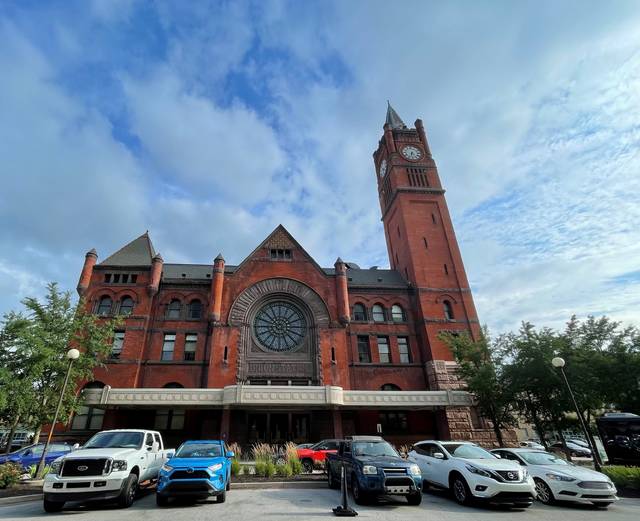
Interested in exploring the former Union Station in downtown Indianapolis but discovering the doors locked, I sought advice from a Crowne Plaza hotel employee.
I thought he would offer some alternative options for my family, but instead he surprised us.
“I’ll take you over,” he offered, and introduced himself.
After Tiny got the assurance from the other employee at the reception desk that his presence could be spared, he escorted us out the hotel door and down the sidewalk to the station.
Upon finding the doors locked, as we had earlier, Tiny radioed a fellow staff member inside to allow us in.
America’s first union station, until it burned down, was located on this site. In 1886, construction began on the current Romanesque-Revival style structure. One million dollars and two years later, the three-story, red brick building was completed.
When the railroad began to see a decline in the late 1960s and 1970s, the grand hall had been boarded up, and plans to demolish it were even discussed. Fortunately, restoration efforts began in the mid 1980s. In 1993, renovation efforts transformed the historic landmark into a marketplace and event venue, and Amtrak still operates out of Indianapolis and maintains a handful of active tracks.
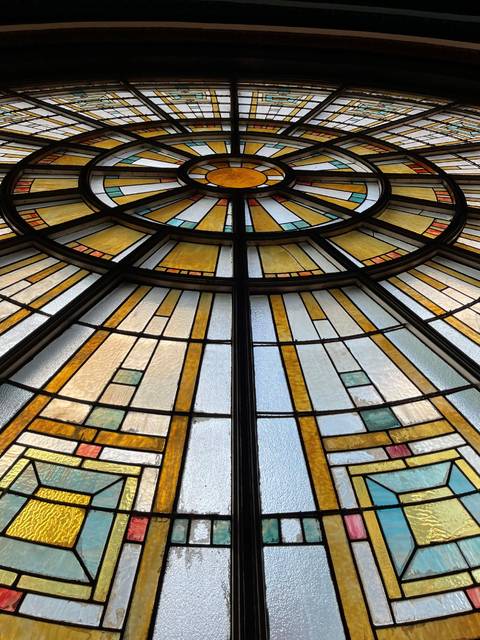
Once inside, Tiny first led us to the great hall where travelers once waited to catch their trains. On each end of the hall are two identical stained-glass wheel windows 20-feet in diameter. And three thousand square feet of stained glass stretches across the ceiling between the two windows.
Once a waiting room surrounded by ticket windows, offices, telephone booths, dining rooms and shops, the massive space was set up for a wedding reception scheduled for the next day. Tables had been meticulously arranged around a dance floor.
Gold curtains hung in the arched openings leading to the adjacent room, and Tiny pushed through those to lead us to a service elevator.
We took the elevator to the basement where Tiny pointed out conspicuous-looking brick walls that closed up spaces he said had been used on the Underground Railroad. The area, he explained, was also used to host parties.
From the basement, we rode the elevator up to the second floor overlooking the event hall. Upstairs, offices and workspaces have replaced hotel rooms.
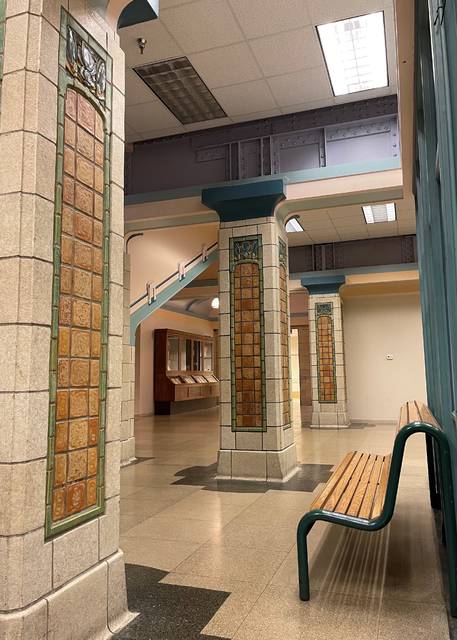
From this vantage point, we got a close look at the stained-glass windows and walls accented with ornate Rookwood tiles.
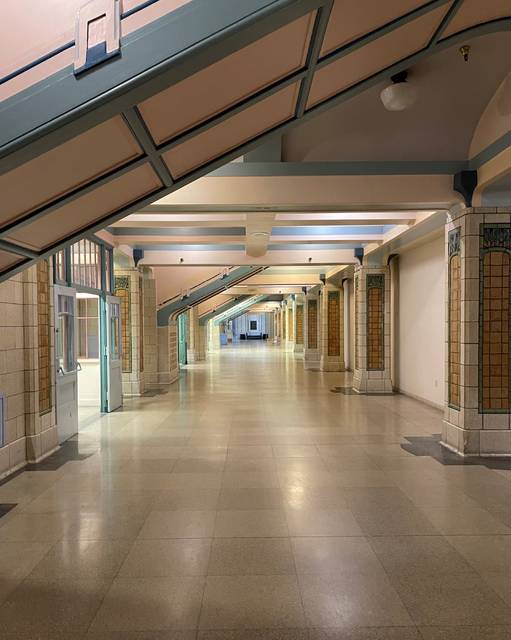
We followed Tiny back to the main floor, where he led us down a long hallway, passing by former ticket windows and stairs that once led to the terminals, and then back down an adjacent hallway.
As we explored the station, it became evident we’d entered a place that begged contemplation beyond what our eyes could see. Our imagination would have to take a turn.
To simply admire the station for the undeniable grandeur of its current state would not be enough. Throughout the years, millions of travelers had moved through its doors. Stood under the sun streaming through its windows.
Those travelers had felt the anticipation of a trip. The anxiety. And the thrill. Had raced across its floors to avoid missing a train. Had delighted upon discovering new places. And perhaps had even marveled at the same impressive surroundings.
Maybe these travelers even appreciated the wonder of transportation, like we often do. About waking up at home in one city and state, and hours later, closing one’s eyes in a city and state miles and miles away.
The Indianapolis Union Railroad Station is recognized by the National Park Service’s Historic American Buildings Survey, further solidifying its importance.
(Note: Marjorie Appelman is an English, communications and journalism teacher at Mason County High School and co-founder of the travel blog, Tales from the Trip, which is on Instagram and Facebook. She can be reached at [email protected].)
Leave a Reply